
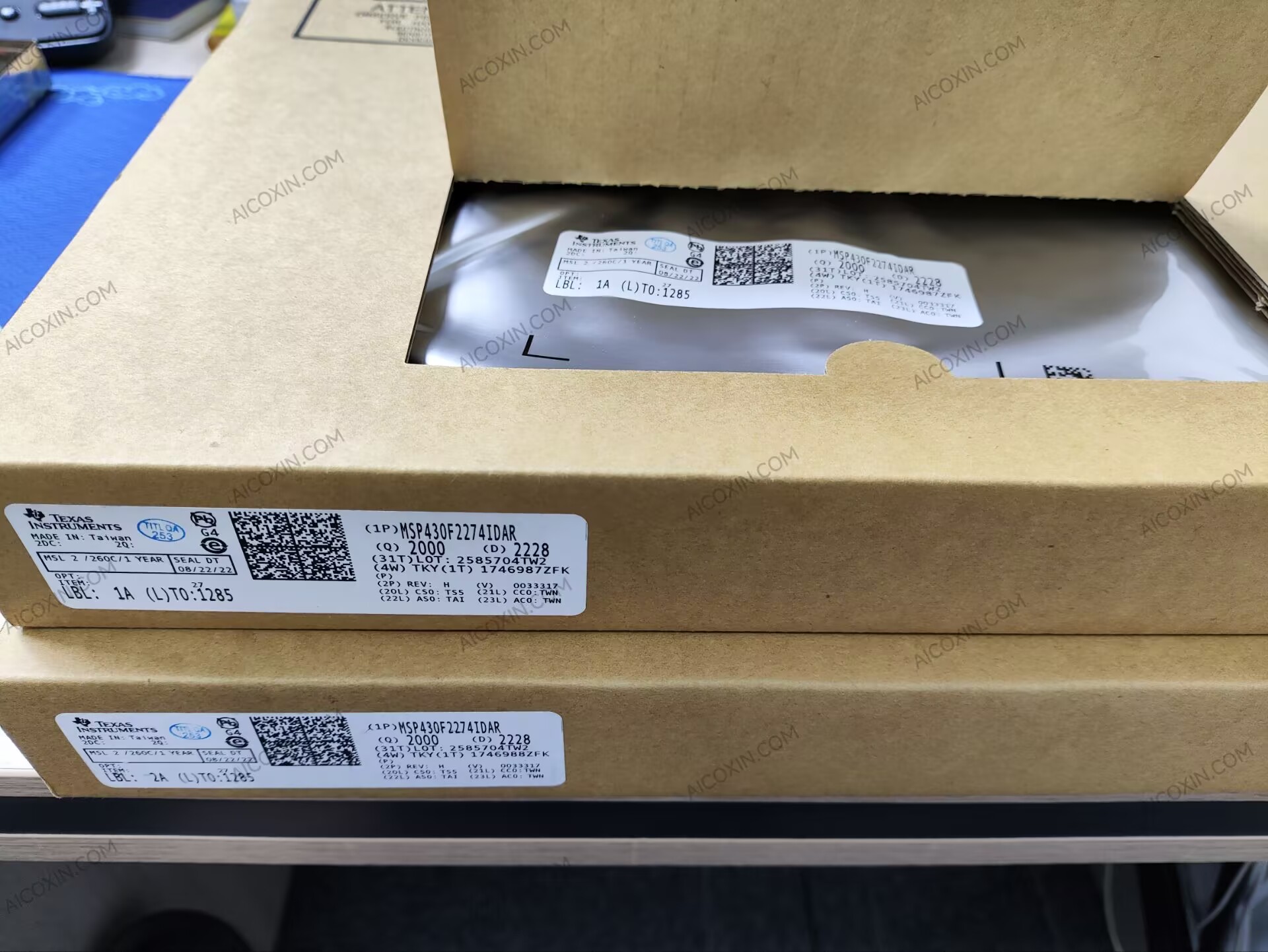

The MSP430F2274IDAR from Texas Instruments is a 16-bit ultra-low-power mixed-signal microcontroller from the MSP430F22x4 family. It uses the MSP430 16-bit RISC CPU architecture, operates at up to 16MHz, and provides a minimum instruction-cycle time of 62.5ns.
The exact MSP430F2274 configuration integrates 32KB of main program Flash, 256 bytes of information Flash, and 1KB of SRAM. Flash can be programmed through JTAG, the bootstrap loader, or in-system by the CPU.
The device supports a 1.8V-to-3.6V supply range. Maximum CPU frequency depends on supply voltage; operation at 16MHz requires approximately 3.0V to 3.6V, so the 1.8V minimum supply rating should not be interpreted as supporting 16MHz at 1.8V.
TI specifies typical ultra-low-power consumption of 270µA in Active mode at 1MHz and 2.2V, 0.7µA in Standby, and 0.1µA in Off mode with RAM retention. The digitally controlled oscillator allows wake-up from low-power modes in less than 1µs.
Analog resources include a 10-bit SAR ADC operating at up to 200ksps with 12 analog input channels, internal reference, sample-and-hold, automatic scanning, and a Data Transfer Controller. Because the MSP430F2274 is an F22x4 device, it also includes two configurable operational amplifiers.
Serial communications are provided by USCI_A0 and USCI_B0. USCI_A0 supports UART with LIN auto-baud detection, IrDA, and SPI, while USCI_B0 supports SPI and I²C.
The MCU includes Timer_A3 and Timer_B3, both 16-bit timer/counters with three capture/compare registers, together with a watchdog timer and brownout detector.
A total of 32 GPIOs are available. Ports P1 and P2 support interrupt capability and programmable pull-up/pull-down resistors, while P3 and P4 provide additional multiplexed general-purpose I/O.
Programming and debugging support includes JTAG, Spy-Bi-Wire, and a bootstrap loader, providing flexible production programming and development options.
The exact MSP430F2274IDAR uses a 38-pin TSSOP package with TI package code DA, with an approximate package footprint of 12.5mm × 8.1mm. This exact orderable version is rated for −40°C to +85°C operation.
The R carrier option is supplied on large tape and reel with 2,000 devices per reel. TI lists RoHS and REACH compliance, NiPdAu lead finish, and an MSL 2 / 260°C / 1-year floor-life rating.
Texas Instruments currently lists the exact MSP430F2274IDAR as ACTIVE.
Key Specifications
- Manufacturer: Texas Instruments
- Manufacturer Part Number: MSP430F2274IDAR
- Family: MSP430F22x4
- Device Type: Ultra-Low-Power MCU
- CPU: MSP430
- Architecture: 16-Bit RISC
- Maximum Frequency: 16MHz
- Minimum Instruction Cycle: 62.5ns
- Main Flash: 32KB
- Information Flash: 256B
- SRAM: 1KB
- GPIO: 32
- Supply Voltage: 1.8V to 3.6V
- 16MHz Supply Range: Approximately 3.0V to 3.6V
- ADC: 10-Bit SAR
- Maximum ADC Rate: 200ksps
- ADC Channels: 12
- Internal ADC Reference: Yes
- Autoscan: Yes
- Data Transfer Controller: Yes
- Configurable Operational Amplifiers: 2
- UART: 1
- LIN Auto-Baud Detection: Yes
- IrDA: Yes
- SPI: Yes
- I²C: Yes
- USCI_A0: UART / LIN / IrDA / SPI
- USCI_B0: SPI / I²C
- Timer_A3: 16-Bit, 3 Capture/Compare Registers
- Timer_B3: 16-Bit, 3 Capture/Compare Registers
- Watchdog Timer: Yes
- Brownout Detector: Yes
- JTAG: Yes
- Spy-Bi-Wire: Yes
- Bootstrap Loader: Yes
- Typical Active Current: 270µA at 1MHz, 2.2V
- Typical Standby Current: 0.7µA
- Typical Off Current: 0.1µA with RAM Retention
- Wake-Up Time: Less Than 1µs
- Package: TSSOP-38
- TI Package Code: DA
- Pin Count: 38
- Package Footprint: Approximately 12.5 × 8.1mm
- Operating Temperature: −40°C to +85°C
- Mounting Type: Surface Mount
- Carrier: Large Tape & Reel
- Standard Reel Quantity: 2,000 pcs
- Lead Finish: NiPdAu
- RoHS: Compliant
- REACH: Compliant
- MSL Rating: Level 2
- Peak Reflow Temperature: 260°C
- Product Status: ACTIVE
Typical Applications
Suitable for portable measurement equipment, sensor acquisition systems, battery-powered controllers, data loggers, instrumentation, analog sensor front ends, low-power embedded control, and RF sensor front-end applications. TI specifically positions the family for systems that acquire analog signals, convert them to digital values, and process them for display or transmission to a host.


Reviews
There are no reviews yet.