
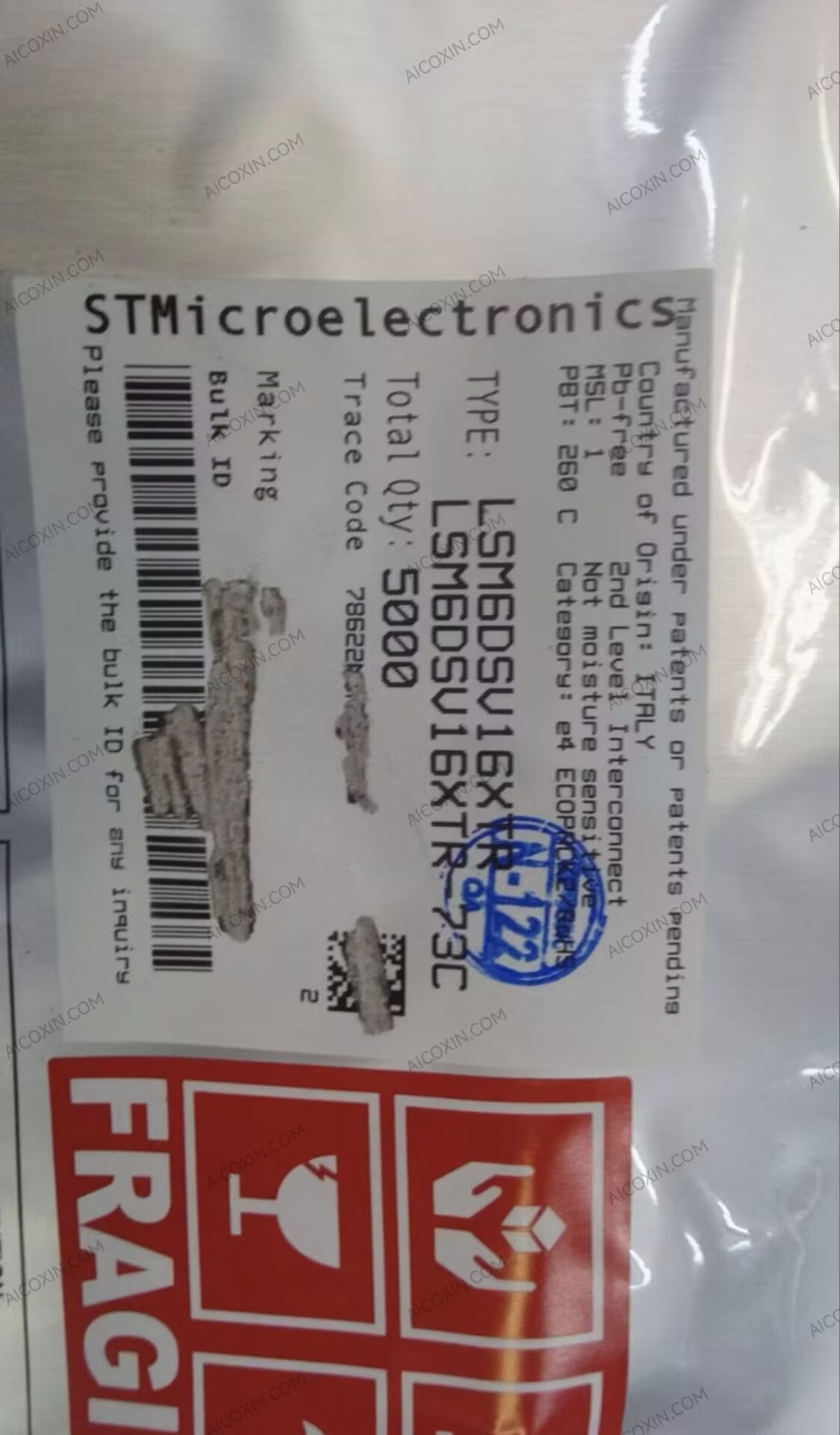
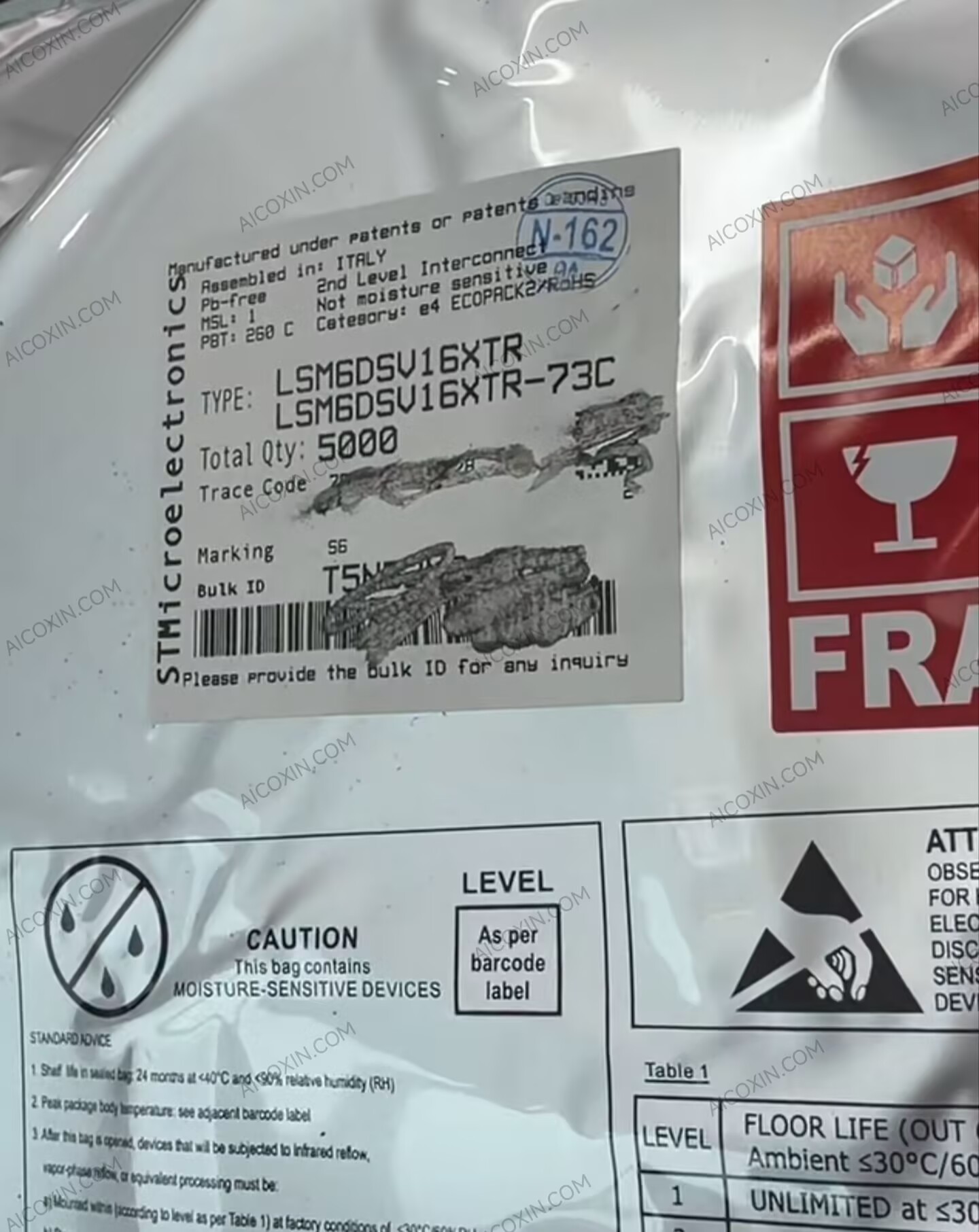

The LSM6DSV16XTR from STMicroelectronics is a high-performance, low-power six-axis inertial measurement unit integrating a three-axis digital accelerometer and a three-axis digital gyroscope. Its triple-channel architecture provides separate configuration, filtering, and processing paths for user-interface, optical-image-stabilization, and electronic-image-stabilization data.
The accelerometer supports selectable full-scale ranges of ±2g, ±4g, ±8g, and ±16g, while the gyroscope supports ±125, ±250, ±500, ±1000, ±2000, and ±4000dps. Both motion sensors support output data rates up to 7.68kHz for fast motion tracking, orientation detection, image stabilization, and vibration monitoring.
An embedded machine-learning core processes motion and external-sensor data directly inside the IMU. It can operate up to four independent decision trees simultaneously, with as many as 16 results per tree and up to 128 total nodes, reducing continuous processing requirements on the host processor.
The device also integrates up to eight programmable finite state machines, adaptive self-configuration, and a sensor-fusion low-power algorithm. The embedded fusion engine generates a game rotation vector, gravity vector, and gyroscope-bias output from accelerometer and gyroscope measurements.
Its integrated Qvar channel detects variations in electric charge for touch and gesture functions such as tap, double tap, triple tap, long press, and left-to-right or right-to-left swipe. An analog hub and digital sensor hub support the acquisition and processing of data from external analog and digital sensors.
The LSM6DSV16XTR includes up to 4.5KB of smart FIFO memory with data compression, dynamic allocation, timestamp storage, and external-sensor batching. This allows the host processor to remain inactive for longer periods, reducing overall system power consumption.
Primary communication options include I²C, SPI, and MIPI I3C v1.1, with an auxiliary SPI interface available for OIS data. The analog supply range is 1.71V to 3.6V, while the independent I/O supply supports 1.08V to 3.6V. Typical current consumption is 0.65mA with both accelerometer and gyroscope operating in high-performance mode.
The device is supplied in a compact 14-lead LGA surface-mount package measuring 2.5mm × 3.0mm, with a typical height of 0.83mm and a maximum height of 0.86mm. It operates from −40°C to +85°C and is supplied in tape-and-reel packaging. ST currently lists LSM6DSV16XTR as an active product in volume production.
Key Specifications
- Manufacturer: STMicroelectronics
- Manufacturer Part Number: LSM6DSV16XTR
- Device Type: Six-Axis Inertial Measurement Unit
- Sensor Configuration: Three-Axis Accelerometer and Three-Axis Gyroscope
- Processing Architecture: Triple Channel for UI, OIS, and EIS
- Accelerometer Full Scale: ±2g, ±4g, ±8g, ±16g
- Gyroscope Full Scale: ±125 to ±4000dps
- Maximum Accelerometer ODR: 7.68kHz
- Maximum Gyroscope ODR: 7.68kHz
- Accelerometer Noise Density: 60μg/√Hz in High-Performance Mode
- Smart FIFO: Up to 4.5KB
- Machine-Learning Core: Integrated MLC
- MLC Decision Trees: Up to Four
- MLC Total Nodes: Up to 128
- Finite State Machines: Up to Eight
- Adaptive Self-Configuration: Supported
- Sensor Fusion: Embedded Low-Power SFLP
- Sensor-Fusion Outputs: Rotation Vector, Gravity Vector, and Gyroscope Bias
- Electrostatic Sensing: Integrated Qvar
- External Digital Sensors: Sensor Hub
- External Analog Input: Analog Hub
- Embedded Motion Functions: Pedometer, Tilt, Significant Motion, Free Fall, Wake-Up, and Orientation
- Primary Interfaces: I²C, SPI, and MIPI I3C v1.1
- Auxiliary Interface: SPI for OIS
- Analog Supply Voltage: 1.71V to 3.6V
- I/O Supply Voltage: 1.08V to 3.6V
- Typical Combo High-Performance Current: 0.65mA
- Operating Temperature: −40°C to +85°C
- Package: LGA-14
- Typical Package Size: 2.5mm × 3.0mm × 0.83mm
- Maximum Package Height: 0.86mm
- Mounting Type: Surface Mount
- Packaging: Tape and Reel
- Compliance: ECOPACK 2 and RoHS
- Product Status: Active / Volume Production
Typical Applications
Suitable for smartphones, smartwatches and other wearable products, AR/VR/MR devices, indoor navigation, IoT devices, gesture recognition, motion tracking, electronic image stabilization, optical image stabilization, and vibration monitoring or compensation. Measurement range, output data rate, noise performance, interface voltage, PCB layout, and power configuration should be evaluated in the final design.


Reviews
There are no reviews yet.